CASE STUDY
Copay
Family App
Product Design
User Research
Design Systems
Year
2022
Industry
Consumer Mobile
Space of work
Product Design
Timeline
2 quarters

Overview
Designing a smarter system for co-parenting
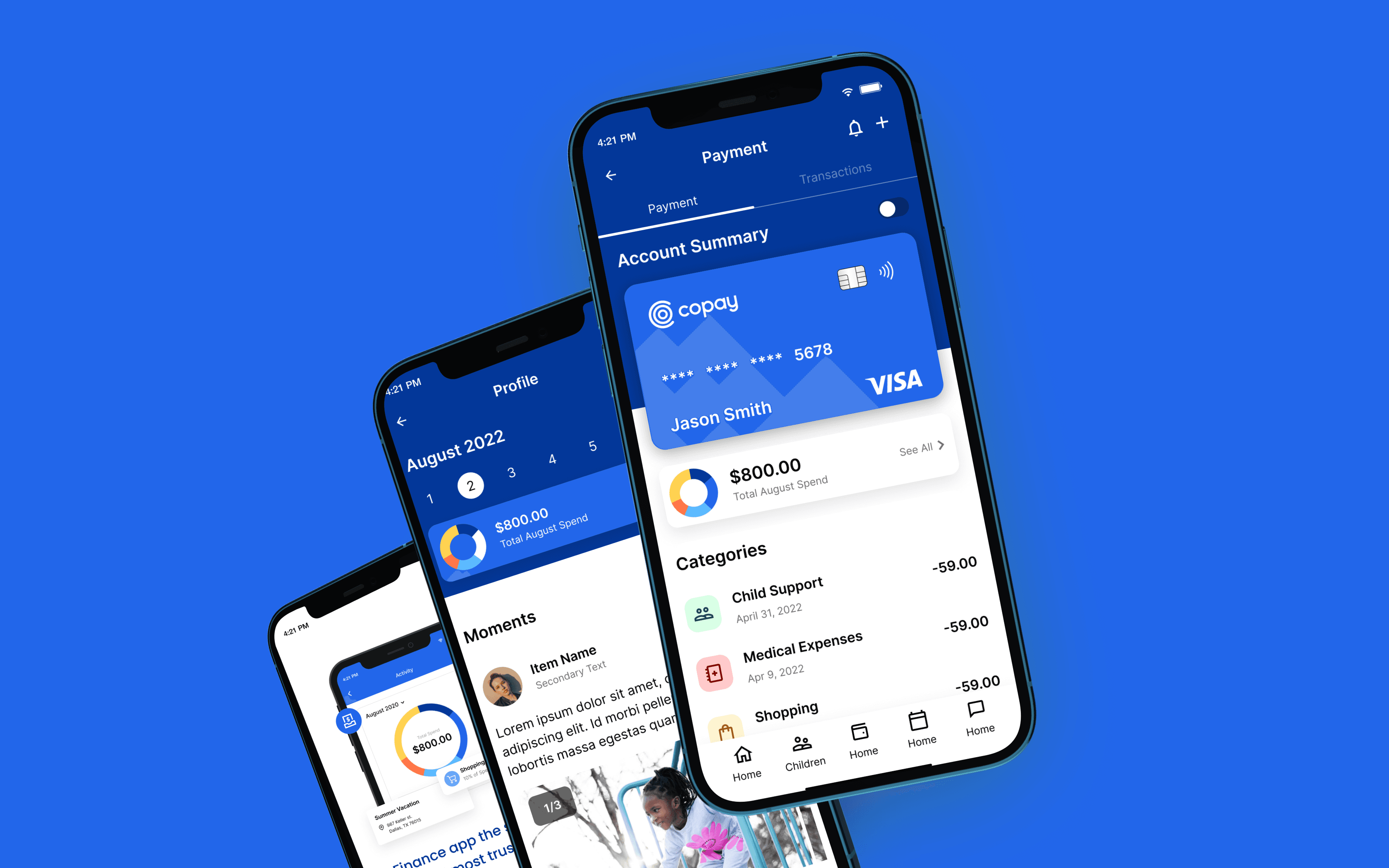
Co-parenting today relies on multiple tools that were never designed to work together. Payments, schedules, and communication are spread across different apps, making it difficult to stay aligned. I led the end-to-end product design, from research and competitive analysis through information architecture, component design, and developer handoff.
Overview
Designing a smarter system for co-parenting
Co-parenting today relies on multiple tools that were never designed to work together. Payments, schedules, and communication are spread across different apps, making it difficult to stay aligned. I led the end-to-end product design, from research and competitive analysis through information architecture, component design, and developer handoff.
Overview
Designing a smarter system for co-parenting
Co-parenting today relies on multiple tools that were never designed to work together. Payments, schedules, and communication are spread across different apps, making it difficult to stay aligned. I led the end-to-end product design, from research and competitive analysis through information architecture, component design, and developer handoff.

THE PROBLEM
Co-parenting is fragmented and difficult to manage
Parents are often forced to track payments, manage schedules, and communicate across separate tools. This creates gaps in information, confusion around responsibilities, and unnecessary tension. Without a shared system, even simple tasks become harder to manage. Important details get lost, and staying aligned requires constant effort instead of being built into the product itself.
THE PROBLEM
Co-parenting is fragmented and difficult to manage
Parents are often forced to track payments, manage schedules, and communicate across separate tools. This creates gaps in information, confusion around responsibilities, and unnecessary tension. Without a shared system, even simple tasks become harder to manage. Important details get lost, and staying aligned requires constant effort instead of being built into the product itself.
THE PROBLEM
Co-parenting is fragmented and difficult to manage
Parents are often forced to track payments, manage schedules, and communicate across separate tools. This creates gaps in information, confusion around responsibilities, and unnecessary tension. Without a shared system, even simple tasks become harder to manage. Important details get lost, and staying aligned requires constant effort instead of being built into the product itself.
THE GOAL
Create clarity without adding pressure
The goal of CoPay was to design a system that brings structure to co-parenting without making it feel heavy or overwhelming. It needed to support payments, schedules, and communication while keeping the experience clear and easy to use. By giving both parents shared visibility into the same information, the product helps reduce confusion and makes it easier to stay aligned.
THE GOAL
Create clarity without adding pressure
The goal of CoPay was to design a system that brings structure to co-parenting without making it feel heavy or overwhelming. It needed to support payments, schedules, and communication while keeping the experience clear and easy to use. By giving both parents shared visibility into the same information, the product helps reduce confusion and makes it easier to stay aligned.
THE GOAL
Create clarity without adding pressure
The goal of CoPay was to design a system that brings structure to co-parenting without making it feel heavy or overwhelming. It needed to support payments, schedules, and communication while keeping the experience clear and easy to use. By giving both parents shared visibility into the same information, the product helps reduce confusion and makes it easier to stay aligned.
RESEARCH & INSIGHTS
Understanding real behavior and pain points
I focused on understanding how co-parenting actually works in practice, not just how it is supposed to work. The biggest challenge was not a lack of tools, but a lack of structure between them.
RESEARCH & INSIGHTS
Understanding real behavior and pain points
I focused on understanding how co-parenting actually works in practice, not just how it is supposed to work. The biggest challenge was not a lack of tools, but a lack of structure between them.
RESEARCH & INSIGHTS
Understanding real behavior and pain points
I focused on understanding how co-parenting actually works in practice, not just how it is supposed to work. The biggest challenge was not a lack of tools, but a lack of structure between them.
What I learned:
01
Parents want clarity, not complexity
They want to quickly understand what’s happening
02
Payments create the most tension
There is often confusion around what was paid and when
03
Communication can lead to conflict
Messages are unstructured and easy to misready.
04
Information is scattered
Documents and schedules are spread across tools
COMPETITIVE ANALYSIS
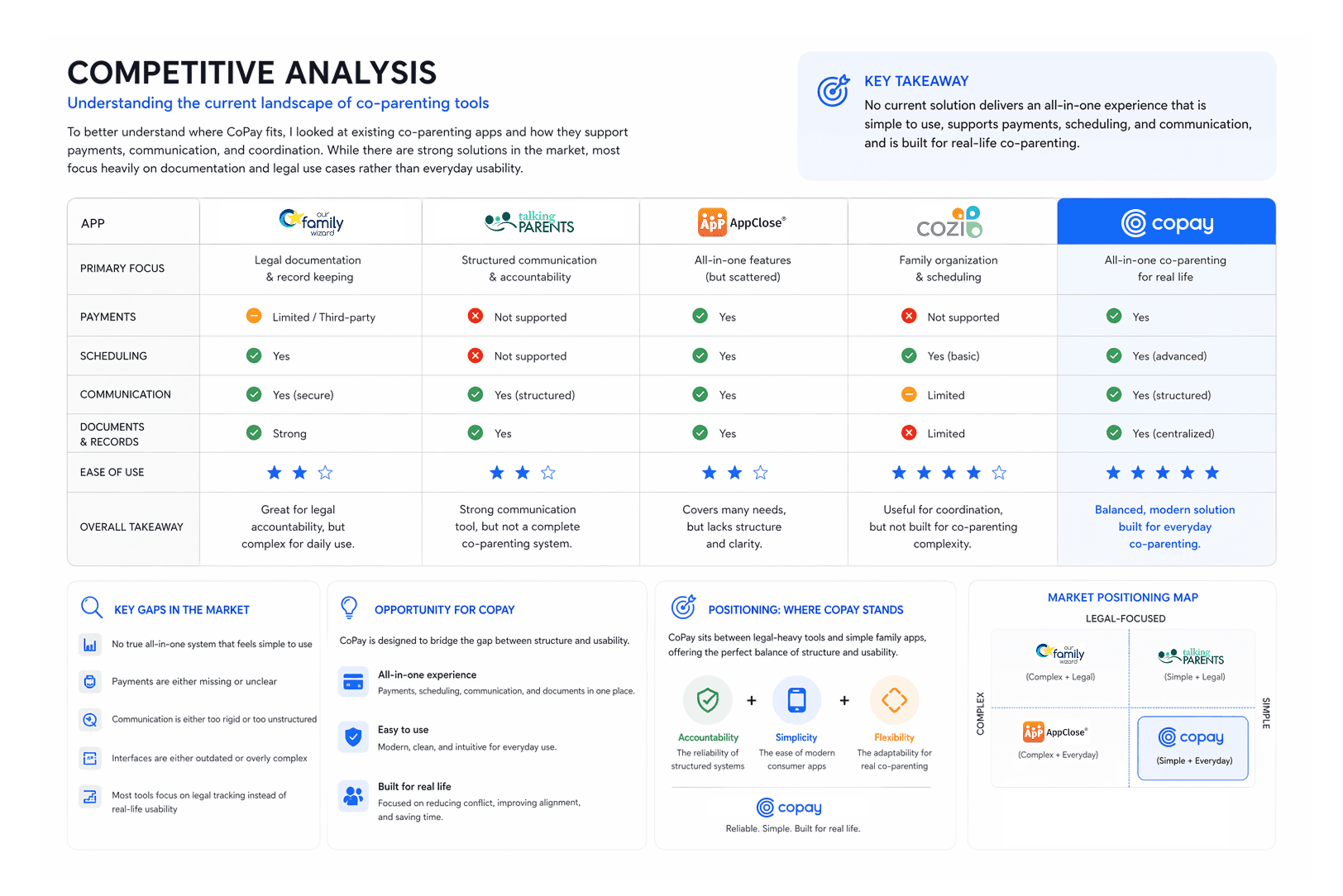
Solving one problem at a time instead of the full experience
Most existing co-parenting tools focus on a single area such as payments, communication, or legal tracking. While they solve specific needs, they do not create a cohesive experience that supports everyday use. This creates gaps between tools, forcing parents to manage multiple systems instead of relying on one. The opportunity for CoPay was to bring these pieces together into a single product that feels complete and usable in real life.
COMPETITIVE ANALYSIS
Solving one problem at a time instead of the full experience
Most existing co-parenting tools focus on a single area such as payments, communication, or legal tracking. While they solve specific needs, they do not create a cohesive experience that supports everyday use. This creates gaps between tools, forcing parents to manage multiple systems instead of relying on one. The opportunity for CoPay was to bring these pieces together into a single product that feels complete and usable in real life.
COMPETITIVE ANALYSIS
Solving one problem at a time instead of the full experience
Most existing co-parenting tools focus on a single area such as payments, communication, or legal tracking. While they solve specific needs, they do not create a cohesive experience that supports everyday use. This creates gaps between tools, forcing parents to manage multiple systems instead of relying on one. The opportunity for CoPay was to bring these pieces together into a single product that feels complete and usable in real life.
PERSONAS
Different roles with a shared responsibility
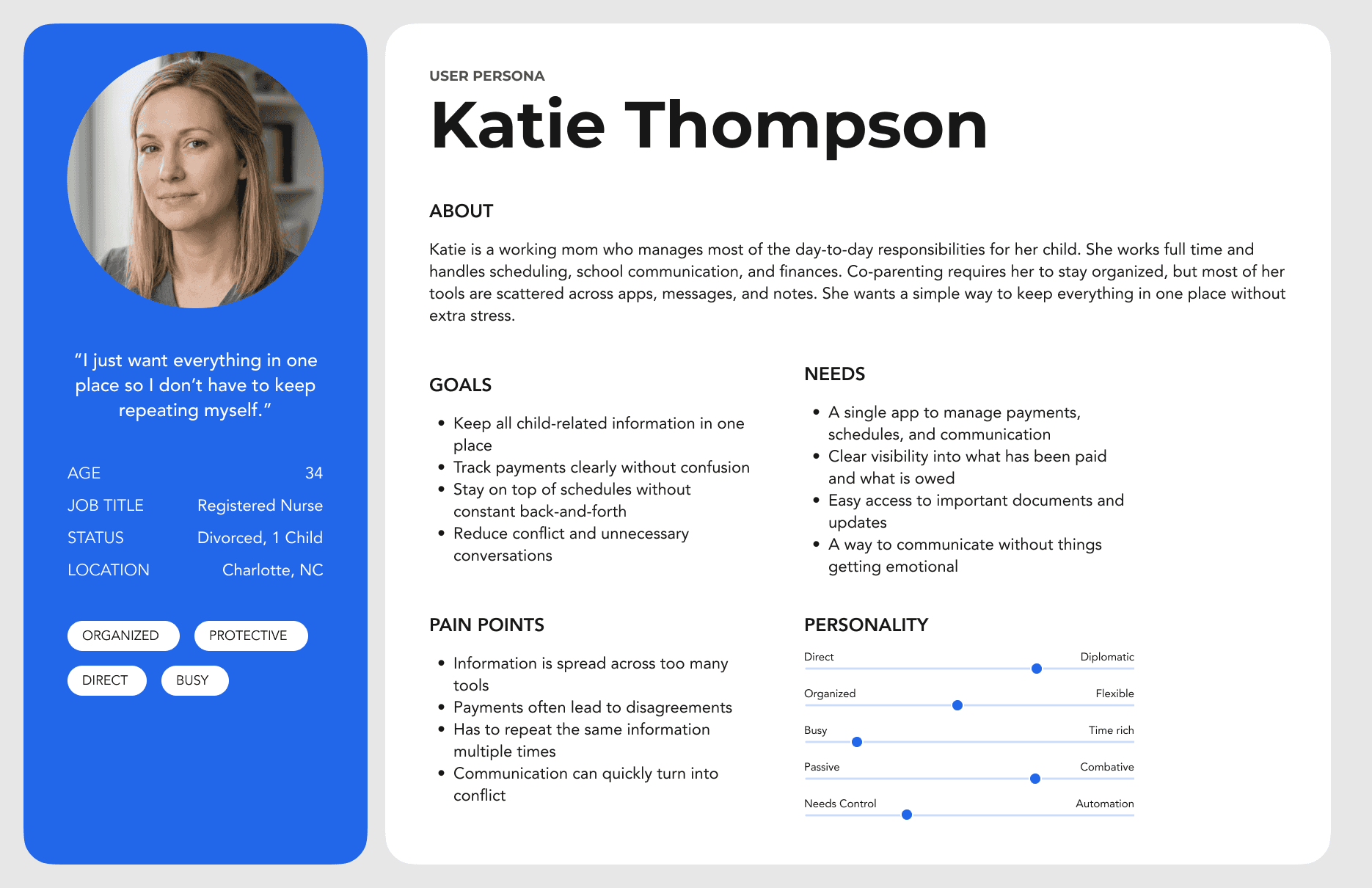
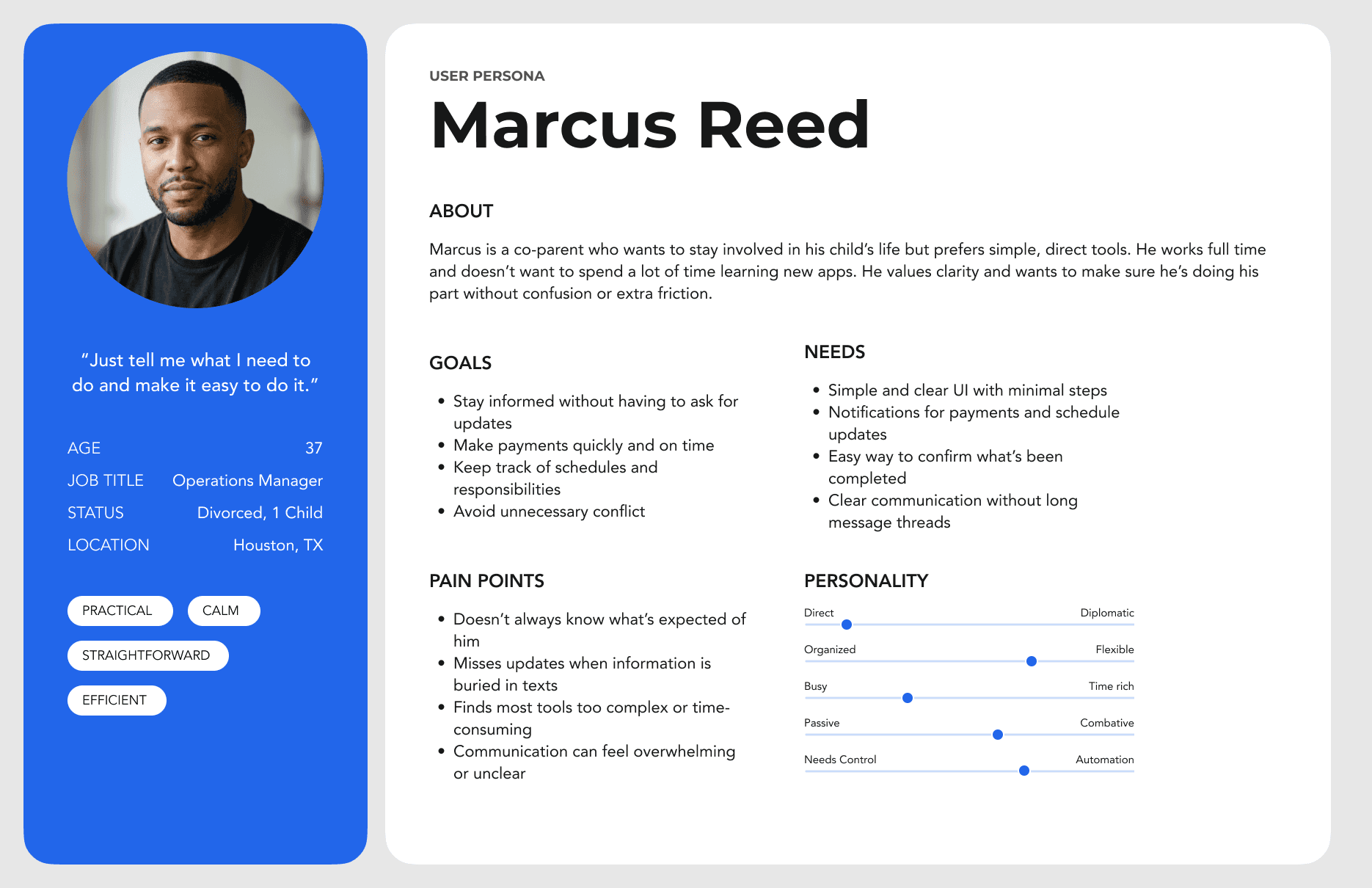
CoPay is designed around two parents who share responsibility but may have different roles and communication styles. The product needed to work for both perspectives while keeping the experience consistent. By focusing on shared visibility instead of individual control, the system supports both users equally and helps reduce friction between them.
PERSONAS
Different roles with a shared responsibility
CoPay is designed around two parents who share responsibility but may have different roles and communication styles. The product needed to work for both perspectives while keeping the experience consistent. By focusing on shared visibility instead of individual control, the system supports both users equally and helps reduce friction between them.
PERSONAS
Different roles with a shared responsibility
CoPay is designed around two parents who share responsibility but may have different roles and communication styles. The product needed to work for both perspectives while keeping the experience consistent. By focusing on shared visibility instead of individual control, the system supports both users equally and helps reduce friction between them.
PROTOTYPE
Using AI to move faster and explore more
I moved quickly from concept to prototype to validate the structure of the product early. Instead of spending time on low fidelity wireframes, I focused on building a working prototype that could be tested and refined. AI tools helped accelerate early exploration and idea generation, but the core decisions were driven by product thinking and user needs. This approach made it easier to iterate quickly while keeping the system grounded in real use cases.
PROTOTYPE
Using AI to move faster and explore more
I moved quickly from concept to prototype to validate the structure of the product early. Instead of spending time on low fidelity wireframes, I focused on building a working prototype that could be tested and refined. AI tools helped accelerate early exploration and idea generation, but the core decisions were driven by product thinking and user needs. This approach made it easier to iterate quickly while keeping the system grounded in real use cases.
PROTOTYPE
Using AI to move faster and explore more
I moved quickly from concept to prototype to validate the structure of the product early. Instead of spending time on low fidelity wireframes, I focused on building a working prototype that could be tested and refined. AI tools helped accelerate early exploration and idea generation, but the core decisions were driven by product thinking and user needs. This approach made it easier to iterate quickly while keeping the system grounded in real use cases.
DESIGN SYSTEM
Creating structure that supports consistency
As the product evolved, I defined a design system to bring consistency across screens and flows. This included establishing patterns, components, and interaction rules that could scale with the product. The goal was to create a system that not only supports design, but also makes it easier for development to implement and maintain over time.
DESIGN SYSTEM
Creating structure that supports consistency
As the product evolved, I defined a design system to bring consistency across screens and flows. This included establishing patterns, components, and interaction rules that could scale with the product. The goal was to create a system that not only supports design, but also makes it easier for development to implement and maintain over time.
DESIGN SYSTEM
Creating structure that supports consistency
As the product evolved, I defined a design system to bring consistency across screens and flows. This included establishing patterns, components, and interaction rules that could scale with the product. The goal was to create a system that not only supports design, but also makes it easier for development to implement and maintain over time.
COMPONENTS
Building reusable patterns for real use
I designed each component to support the core flows of the product, with a focus on flexibility and reuse. Each one handles real scenarios: payments, schedules, and shared information between parents. Building reusable patterns from the start kept the product consistent as it grew and made the development handoff significantly cleaner.
COMPONENTS
Building reusable patterns for real use
I designed each component to support the core flows of the product, with a focus on flexibility and reuse. Each one handles real scenarios: payments, schedules, and shared information between parents. Building reusable patterns from the start kept the product consistent as it grew and made the development handoff significantly cleaner.
COMPONENTS
Building reusable patterns for real use
I designed each component to support the core flows of the product, with a focus on flexibility and reuse. Each one handles real scenarios: payments, schedules, and shared information between parents. Building reusable patterns from the start kept the product consistent as it grew and made the development handoff significantly cleaner.
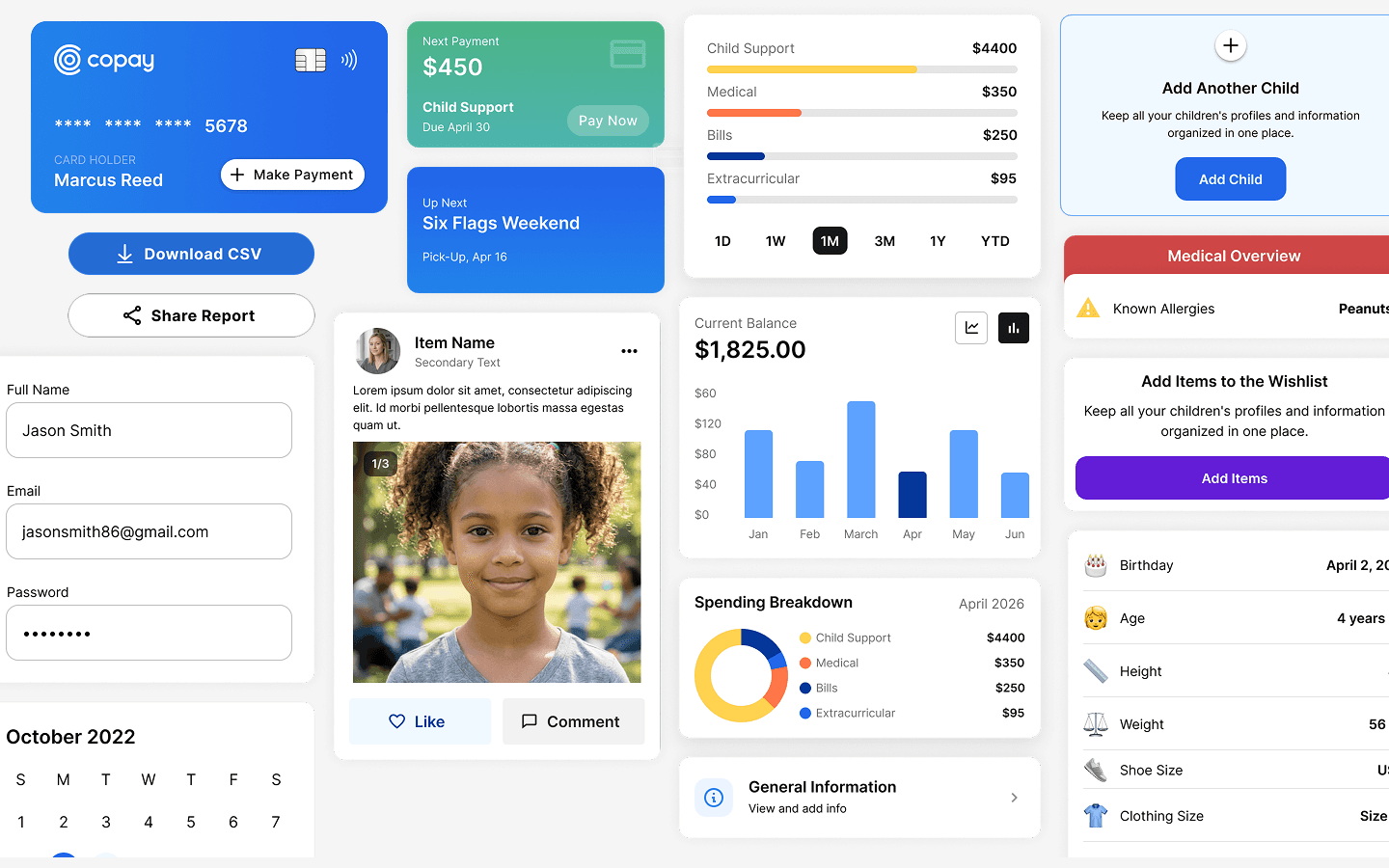
A single source of truth for each child
The child profile acts as the foundation of the product, bringing together all relevant information into one place. This includes personal details, school information, medical records, and shared lists. By centralizing this information, both parents have access to the same data, reducing confusion and making it easier to stay organized.
A single source of truth for each child
The child profile acts as the foundation of the product, bringing together all relevant information into one place. This includes personal details, school information, medical records, and shared lists. By centralizing this information, both parents have access to the same data, reducing confusion and making it easier to stay organized.
Removing ambiguity from shared expenses
Payments are one of the most sensitive parts of co-parenting. This flow was designed to create transparency and remove uncertainty around what has been paid and when. By tracking transactions, supporting recurring payments, and providing a clear history, the system helps reduce tension and keeps both parents aligned.
Removing ambiguity from shared expenses
Payments are one of the most sensitive parts of co-parenting. This flow was designed to create transparency and remove uncertainty around what has been paid and when. By tracking transactions, supporting recurring payments, and providing a clear history, the system helps reduce tension and keeps both parents aligned.
OTHER FLOWS
Supporting the full co-parenting experience
Beyond payments and profiles, the product includes scheduling, messaging, and document management. Each flow is designed to work within the same system, creating a consistent experience across the product. The focus was on making each interaction simple while ensuring everything connects back to a shared structure.
OTHER FLOWS
Supporting the full co-parenting experience
Beyond payments and profiles, the product includes scheduling, messaging, and document management. Each flow is designed to work within the same system, creating a consistent experience across the product. The focus was on making each interaction simple while ensuring everything connects back to a shared structure.
OTHER FLOWS
Supporting the full co-parenting experience
Beyond payments and profiles, the product includes scheduling, messaging, and document management. Each flow is designed to work within the same system, creating a consistent experience across the product. The focus was on making each interaction simple while ensuring everything connects back to a shared structure.
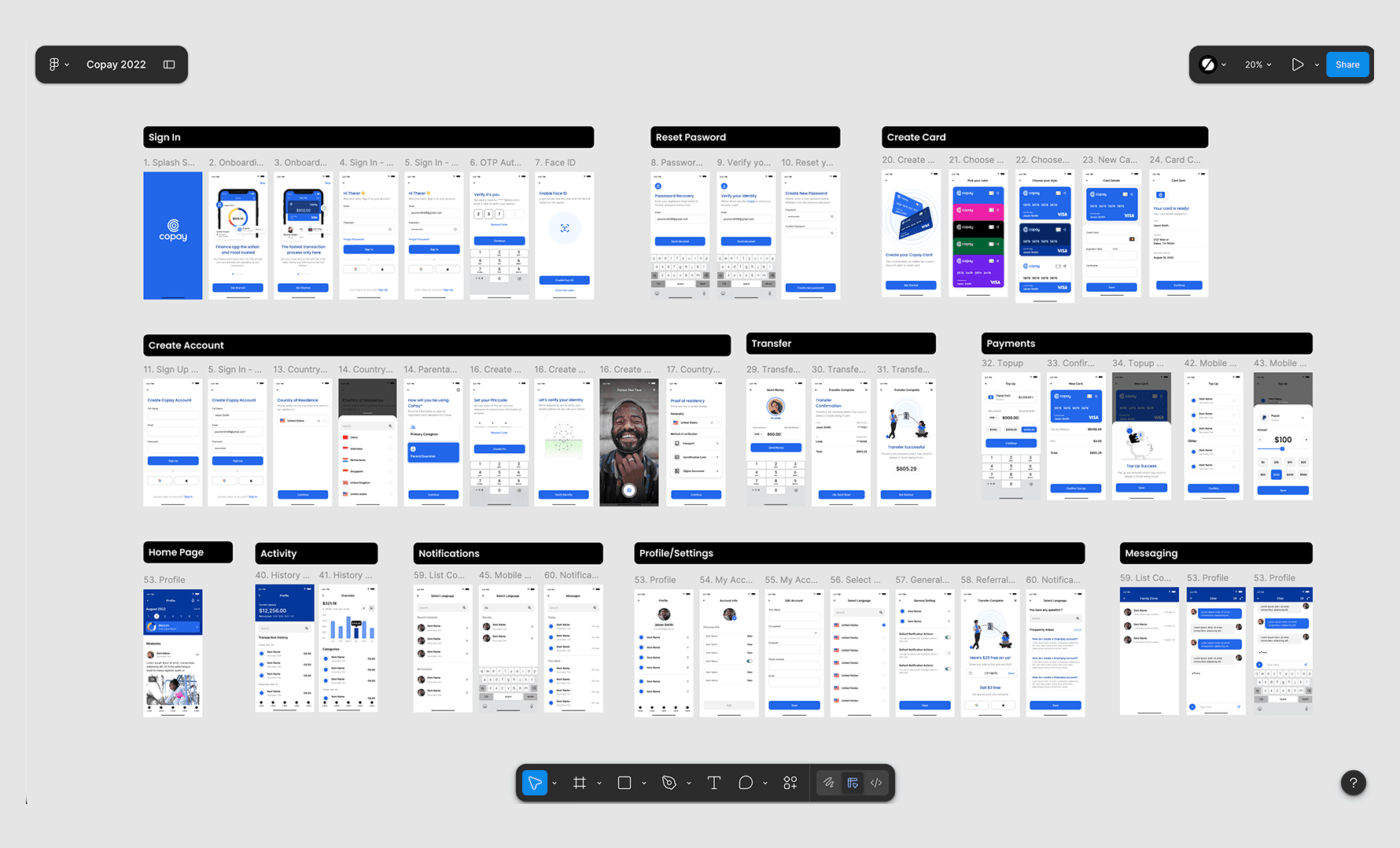
DEV HANDOFF
Designing for real implementation
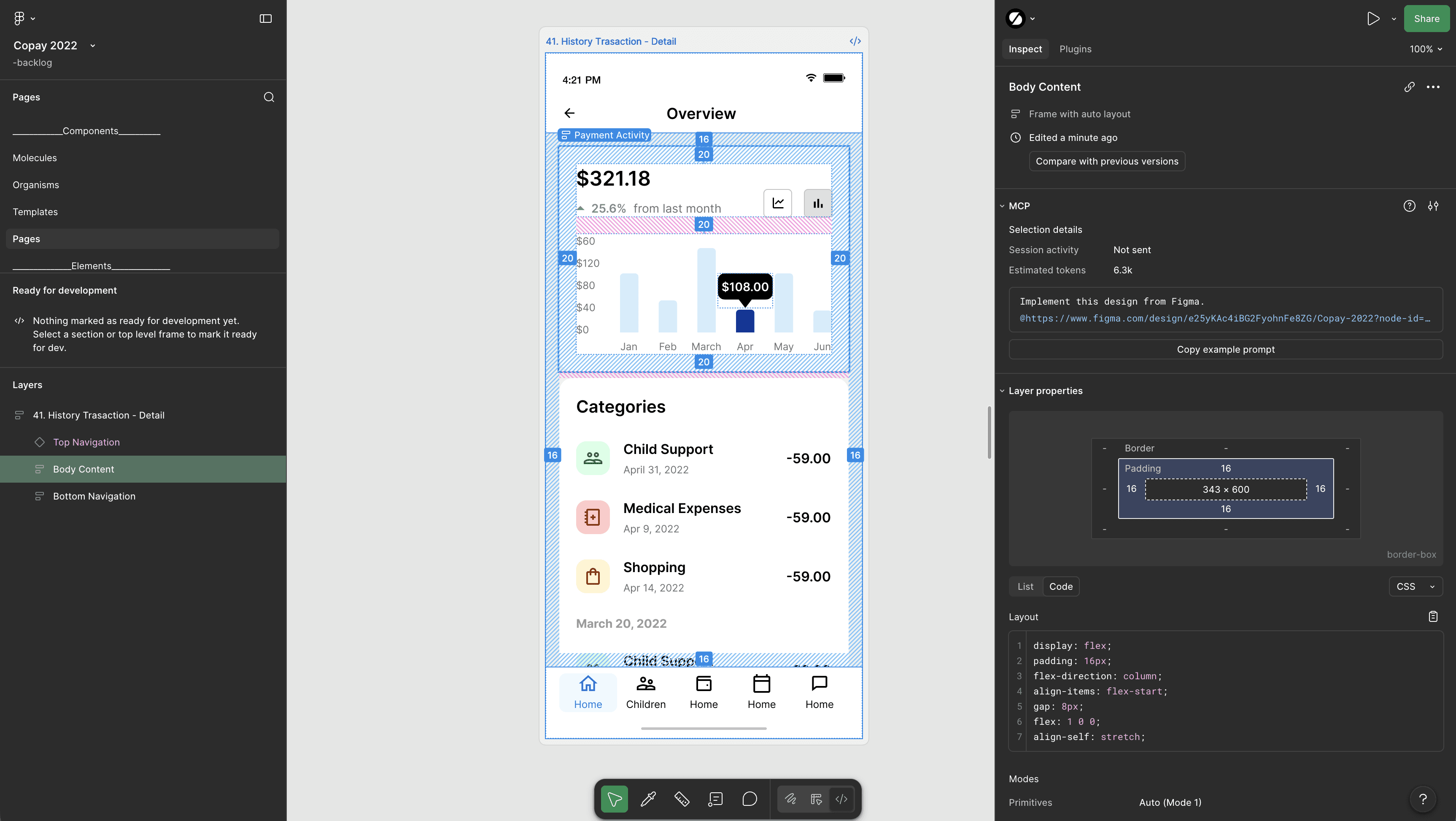
I made sure every design decision translated cleanly into development. Components were organized, behaviors were defined, and edge cases were documented before anything moved to build. The goal was to remove as much ambiguity from the handoff as possible.
DEV HANDOFF
Designing for real implementation
I made sure every design decision translated cleanly into development. Components were organized, behaviors were defined, and edge cases were documented before anything moved to build. The goal was to remove as much ambiguity from the handoff as possible.
DEV HANDOFF
Designing for real implementation
I made sure every design decision translated cleanly into development. Components were organized, behaviors were defined, and edge cases were documented before anything moved to build. The goal was to remove as much ambiguity from the handoff as possible.
MY KEY LEARNINGS
Clarity matters more than features
MY KEY LEARNINGS
Clarity matters more than features
I approached this like a fast-moving startup, combining research with AI to move quickly.
MY KEY LEARNINGS
Clarity matters more than features
I approached this like a fast-moving startup, combining research with AI to move quickly.
01
Simplification drives impact
Reducing complexity improved usability more than expanding functionality. Clear information made the product easier to navigate and use.
02
Shared context builds trust
Providing both users with the same information helped reduce tension and improved decision making.
03
Design influences behavior
Intentional structure led to more consistent interactions and fewer communication issues.
04
Integration adds value
Combining key features into one system created a stronger experience than relying on separate tools.